If you're a car dealer in Almaty, Tashkent, Bishkek, or Dushanbe, you've probably asked yourself these questions: What certificates do I actually need to clear this shipment? Does EAC cover Uzbekistan or not? Why did customs seize that last batch?
You're not alone. Central Asia is importing Chinese vehicles at record volumes — Kazakhstan alone took 124,194 units from China in 2024, up 25.2% year-on-year — but the certification landscape remains a patchwork of overlapping and sometimes conflicting rules[1].
This guide answers the practical questions that matter to dealers: which documents you need, what's changed recently, and how to avoid the mistakes that get vehicles stuck at the border.
A note on sources: The regulatory information in this guide comes from the Export Commodity Technical Guide — Auto Vehicle Certification (2025 Edition), published by the China Chamber of Commerce for Import and Export of Machinery and Electronic Products (CCCME) and compiled by experts from the China Automotive Technology and Research Center (CATARC)[2]. While labeled "2025 Edition," its data cutoff is December 2024 — and as of mid-2026, it remains the most current publicly available regulatory reference for the region. Where newer developments (such as Kyrgyzstan's 2025 import crackdown) are known, we've incorporated them from official government announcements.
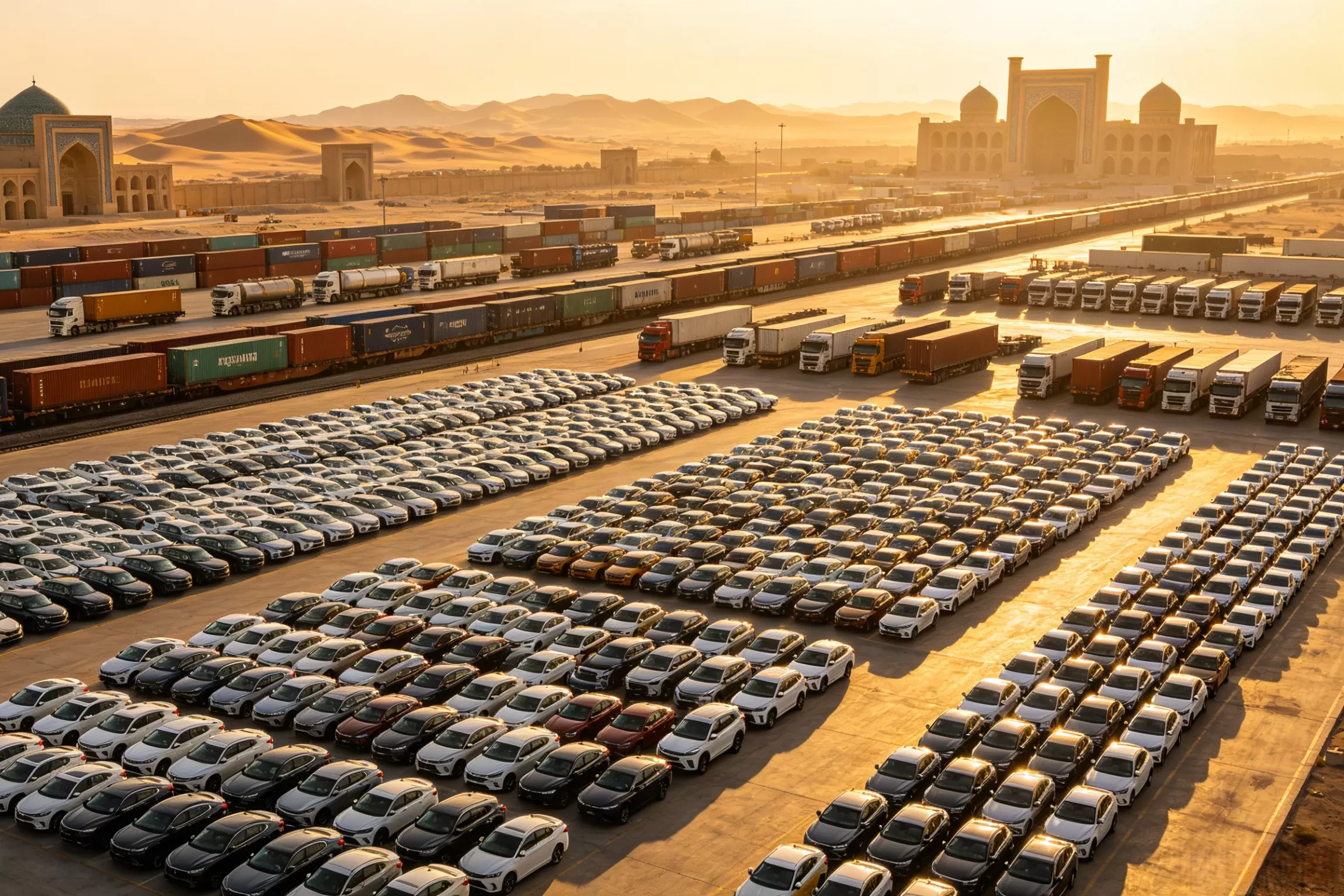
1. Know Your Market: One Region, Three Rulebooks
The first thing every Central Asian dealer needs to understand: there is no single "Central Asian" certification. You're dealing with three distinct systems[3].
1.1. The EAEU Zone: Kazakhstan and Kyrgyzstan
Both countries are members of the Eurasian Economic Union (EAEU), which means they share a unified technical regulation — TP TC 018/2011 on wheeled vehicle safety[4]. A vehicle type approval (OTTC) obtained in one EAEU country is valid in all five member states: Russia, Kazakhstan, Belarus, Kyrgyzstan, and Armenia.
| What this means for you | What's required |
|---|
| One OTTC = access to five markets | ~70 individual system certifications for M1 vehicles |
| Vehicles flow freely across EAEU borders | EAC mark on every unit |
| But enforcement varies by country | Kazakhstan: strict; Kyrgyzstan: tightening fast |
Kazakhstan dominates — accounting for approximately 87% of all EAEU vehicle sales[5]. If you're importing into Central Asia at scale, Kazakhstan is almost certainly your primary destination or transit hub.
1.2. The Independent Path: Uzbekistan
Uzbekistan is not an EAEU member[6]. It operates its own certification regime under the Agency for Technical Regulation (ATR) and the State Committee for Ecology and Environmental Protection (SCEEP). The good news: the system is well-structured and heavily aligned with UNECE standards, making it one of the more predictable markets once you understand the requirements.
1.3. The GOST Legacy: Tajikistan and Turkmenistan
Both countries rely on national standards (GOST and local variants) with varying degrees of enforcement[7]. Process is generally less complex than EAEU or Uzbekistan, but documentation requirements can be less standardized — which means more room for interpretation at the border.
2. Kazakhstan: Your EAEU Gateway
If you're importing into Central Asia, Kazakhstan is likely your entry point — and the OTTC (俄语: ОТТС) is the document that matters most.
2.1. What the OTTC Actually Is
The OTTC is a vehicle type approval certificate valid across all five EAEU states[8]. Its regulatory architecture mirrors the EU's Whole Vehicle Type Approval framework (2007/46/EC), with heavy adoption of UNECE regulations. For an M1 passenger vehicle, you need certification across approximately 70 individual systems[9]:
Lighting and signaling: ECE R1 through R8, R19, R23, R38, R48, R87, R91, R119
Braking: ECE R13H (ESC and BAS mandatory)
Safety: ECE R12 (steering), R14/R16 (seatbelts/ISOFIX), R94/R95 (front/side impact)
Emissions: UN R83.06 (M1/N1), UN R49.05 (diesel)
EV-specific: ECE R100 (battery safety), ECE R101 (CO₂/fuel consumption)
Russia-specific: GLONASS emergency call system
GOST-only items: Interior noise, cabin air quality (GOST 33554-2015), defrost/demist, vehicle stability
2.2. Four Changes That Affect Your Imports Right Now
Kazakhstan has tightened its import regime significantly since late 2024. Here's what dealers need to know[10]:
1. Stricter documentation. First-time OTTC applicants must now submit a manufacturer production condition inspection report. Ongoing imports require periodic production analysis updates. If your Chinese supplier hasn't prepared these, expect delays.
2. Local representative mandate. Non-EAEU manufacturers — including Chinese automakers and exporters — must designate a local representative in Kazakhstan who signs joint-liability agreements. If a safety defect emerges, the local entity shares legal responsibility. This isn't optional; it's a hard requirement.
3. New-vehicle import restrictions. Since December 2024, vehicles manufactured within the last three years can only be imported by legal entities explicitly named in the OTTC. Individual imports face steep duties. Translation: if you're a small dealer importing in your own name, the economics just got worse. Working through an established entity with OTTC coverage is now the practical path.
4. Data localization for connected vehicles. Personal data collected by intelligent connected vehicles must be stored on servers within Kazakhstan, encrypted to at least Level 3 under national standard ST RK 34.016-2017[11]. If you're importing Chinese EVs with telematics or ADAS features, factor this into your compliance planning.
3. Uzbekistan: Two Certificates, One Market
Uzbekistan requires dual certification: safety and environmental. Both are mandatory, and they're handled by different agencies[12].
3.1. Vehicle Safety Approval (VTA)
Administered by the Agency for Technical Regulation (ATR), the VTA is based on UzTR.237-016:2017 — a comprehensive technical regulation that draws primarily from UNECE standards, supplemented by Russian GOST and local Uzbek DST standards for items not covered by UNECE[13].
Key details for dealers:
| Item | Detail |
|---|
| Type approval validity | 3 years for mass-produced vehicles |
| Certificate holder | Manufacturer or authorized carrier representative |
| SKD/CKD vehicles | Can submit type approval reports based on UNECE; additional testing may be required |
| M1 certification items | Approximately 58 items covering lighting, braking, safety, emissions, EV (ECE R100), pedestrian protection (ECE R127), interior VOC, and climate/geographic adaptability (UzDSt 3311:2018) |
3.2. Environmental Certification
Since January 1, 2022, all M and N category vehicles entering Uzbekistan must meet Euro-4 emission standards as a minimum[14]. This is enforced by SCEEP under regulation 30.01.2020-50. If you're importing older Euro-3 vehicles, they won't clear — plan your sourcing accordingly.
3.3. The Localization Opportunity — and Requirement
Uzbekistan is actively courting Chinese automotive investment with a clear value proposition. Over 40% local procurement qualifies for tax incentives and priority customs treatment[15]. Changan has partnered with a local firm to produce the Deepal S07; BYD has established a joint-venture plant. For dealers importing at volume, a local assembly or CKD strategy may significantly reduce per-unit costs.
4. Kyrgyzstan: EAEU Member, New Enforcement Reality
Kyrgyzstan shares the EAEU's EAC/OTTC framework, but the operating environment changed dramatically in early 2025[16].
4.1. The Import Crackdown
In January 2025, the President signed a decree targeting illegally imported vehicles. The State Agency for Vehicle and Driver Registration launched a three-phase legalization program[17]:
| Phase | Timeline | Scope |
|---|
| Phase 1 | April–October 2025 | Vehicles with ownership documentation |
| Phase 2 | Estimated May 2025 | Vehicles without ownership documents, good technical condition |
| Phase 3 | TBD | Disposal: dismantle, re-export, or scrap |
Simultaneously, customs has increased scrutiny of vehicles transiting through other EAEU countries. In January 2025 alone, 510 vehicles imported from Armenia were seized for incomplete documentation[18]. If you're routing vehicles through EAEU transit hubs, your paperwork needs to be airtight.
4.2. The Strategic Angle
Kyrgyzstan is actively attracting Chinese automotive investment. In February 2025, firms including Lifan Battery and Derui New Energy signed agreements for NEV assembly and charging infrastructure with annual capacity of 10,000 units[19]. Vehicles assembled in Kyrgyzstan under EAC certification can flow into the Russian market — a significant advantage given current sanctions-related supply constraints. For dealers, this creates both a supply opportunity and a potential competitive pressure as locally-assembled units enter the market.
5. Tajikistan and Turkmenistan: Lower Volume, Simpler Rules
5.1. Tajikistan
Mandatory technical inspection for all vehicles under the Road Traffic Law[20]. For high-risk vehicle categories (buses, hazardous goods carriers), full certification with factory audit is required. Lower-risk products can use a declaration of conformity with third-party test reports. The national standardization body, Tajikstandart, oversees all certification activities.
5.2. Turkmenistan
All imported vehicles require mandatory certification under the national Certification Law[21]. The system uses Turkmen national standards (TDS) alongside CIS GOST standards. One notable advantage for regular importers: Turkmen certificates have long-term validity — a single product sample certification covers ongoing imports, reducing per-shipment compliance costs.
6. What About Electric and Connected Vehicles?
6.1. New Energy Vehicles
| Country | NEV Certification Status[22] |
|---|
| Uzbekistan | Most advanced: VTA + environmental track, ECE R100 battery safety, lifecycle assessment, recycling compliance |
| Kazakhstan | Standard OTTC flow applies; no separate emissions targets for NEVs yet; tariff incentives under discussion |
| Kyrgyzstan | Framework under development; expected to follow EAEU standards |
| Tajikistan/Turkmenistan | Early stage; technical standards (range, charging), certification procedures, and market incentives expected to develop |
6.2. Intelligent Connected Vehicles
Key points for dealers importing Chinese EVs with ADAS or telematics[23]:
Kazakhstan: Data must be stored domestically; electromagnetic compatibility and data security testing required for OTTC; L3+ autonomous driving not yet permitted; expected to follow UNECE WP.29 R157 (ALKS) in future
Uzbekistan: Directly adopting Chinese ICV standards — including ADAS testing protocols and OTA update management requirements; ICV road testing pilots underway; L3 may be permitted in designated zones
Kyrgyzstan: Allows temporary entry of foreign-plated vehicles; ICV framework still developing
Tajikistan/Turkmenistan: Minimal ICV regulation at present
7. Six Takeaways for Central Asian Auto Dealers
1. Start with Kazakhstan. An OTTC obtained through Kazakhstan opens five EAEU markets. Get this right first, and the rest of the region becomes easier.
2. Uzbekistan requires separate certification. Budget 3–6 months for full VTA + environmental approval. The framework is UNECE-aligned and predictable — but it's a separate process from EAEU.
3. Documentation is no longer negotiable. Kyrgyzstan's crackdown and Kazakhstan's 2025 documentation requirements mean that incomplete paperwork will get your vehicles seized — not just delayed.
4. Localization is the direction of travel. Every Central Asian government is offering incentives for local assembly. If you're importing 100+ units annually, a CKD partnership may outperform pure CBU imports on cost.
5. EV certification is manageable but not automatic. ECE R100 battery safety is the regional baseline. Uzbekistan adds lifecycle and recycling requirements. Budget for these additional testing items when sourcing NEVs.
6. Partner selection matters more than ever. With Kazakhstan's local representative mandate, Kyrgyzstan's enforcement surge, and Uzbekistan's localization requirements, working with an experienced export partner who understands the full certification chain can mean the difference between a shipment that clears in days and one that sits in customs for months.
This guide is based on the CCCME/CATARC "Export Commodity Technical Guide — Auto Vehicle Certification" (2025 Edition), supplemented by official government announcements for developments after the December 2024 data cutoff. While every effort has been made to ensure accuracy, regulations change. Always verify current requirements with local authorities or your certification partner before shipping.
About the Author / Sourcing Partner
This guide was prepared by the supply chain intelligence team at Zacarmate (Zhongan TikTech (Anhui) Co., Ltd.), the professional auto export arm of Fortune Global 500 company Conch Group. We help Central Asian dealers source, certify, and ship vehicles from China — handling the full EAC/OTTC/VTA documentation chain so you don't have to navigate it alone.
How we support Central Asian dealers:
Full certification support: EAC, OTTC, VTA, and GOST documentation prepared by specialists who know each market's requirements
Multi-brand sourcing: New energy (BEV/PHEV), ICE (sedan/SUV/pickup), used vehicles — 80%+ of mainstream Chinese brands
Dealer-friendly terms: MOQ = 1 unit for trial orders; multi-brand mixed-container shipping to all Central Asian destinations
End-to-end logistics: Domestic short-haul, warehousing, international rail/road/container transport covering Almaty, Tashkent, Bishkek, Dushanbe, and beyond
Local compliance: In-market representative partnerships for Kazakhstan's OTTC mandate and Uzbekistan's localization requirements
→ Contact our export desk for a tailored Central Asia sourcing and certification plan.

CCCME/CATARC (2025), Chapter 1, Table 6 — 2024 vehicle export destination ranking.↩︎
CCCME/CATARC (2025), Preface.↩︎
CCCME/CATARC (2025), Chapters 7-8.↩︎
CCCME/CATARC (2025), Chapter 7.1.1 — EAEU overview.↩︎
CCCME/CATARC (2025), Chapter 7.1.1.↩︎
CCCME/CATARC (2025), Chapter 8.1.↩︎
CCCME/CATARC (2025), Chapters 8.3-8.4.↩︎
CCCME/CATARC (2025), Chapter 7.1.2 — EAEU certification system.↩︎
CCCME/CATARC (2025), Chapter 7.2, Table 23 — EAEU M1 certification items.↩︎
CCCME/CATARC (2025), Chapter 7.2; Chapter 8.6 (Kazakhstan ICV section, 2025 new regulations).↩︎
CCCME/CATARC (2025), Chapter 8.6 — Kazakhstan data localization requirements.↩︎
CCCME/CATARC (2025), Chapter 8.1 — Uzbekistan certification overview.↩︎
CCCME/CATARC (2025), Chapter 8.1, Table 24 — Uzbekistan M1 certification items.↩︎
CCCME/CATARC (2025), Chapter 8.1 — Uzbekistan environmental certification, Euro-4 requirement.↩︎
CCCME/CATARC (2025), Chapter 8.6 — Uzbekistan localization policies and ICV standards.↩︎
CCCME/CATARC (2025), Chapter 8.2 — Kyrgyzstan certification system.↩︎
CCCME/CATARC (2025), Chapter 8.2 — Three-phase legalization program.↩︎
CCCME/CATARC (2025), Chapter 8.2 — 510 vehicles seized.↩︎
CCCME/CATARC (2025), Chapter 8.2 — Chinese investment and local production.↩︎
CCCME/CATARC (2025), Chapter 8.3 — Tajikistan certification.↩︎
CCCME/CATARC (2025), Chapter 8.4 — Turkmenistan certification.↩︎
CCCME/CATARC (2025), Chapter 8.5 — Central Asia NEV requirements.↩︎
CCCME/CATARC (2025), Chapter 8.6 — Central Asia ICV requirements.↩︎
Zhongan TikTech (Anhui) Co., Ltd.
Zhongan TikTech (Anhui) Co., Ltd., a Conch Group SOE, exports quality new & used vehicles globally with 40+ years' foreign trade expertise.

 EN
EN
 fr
fr  es
es  ru
ru  pt
pt