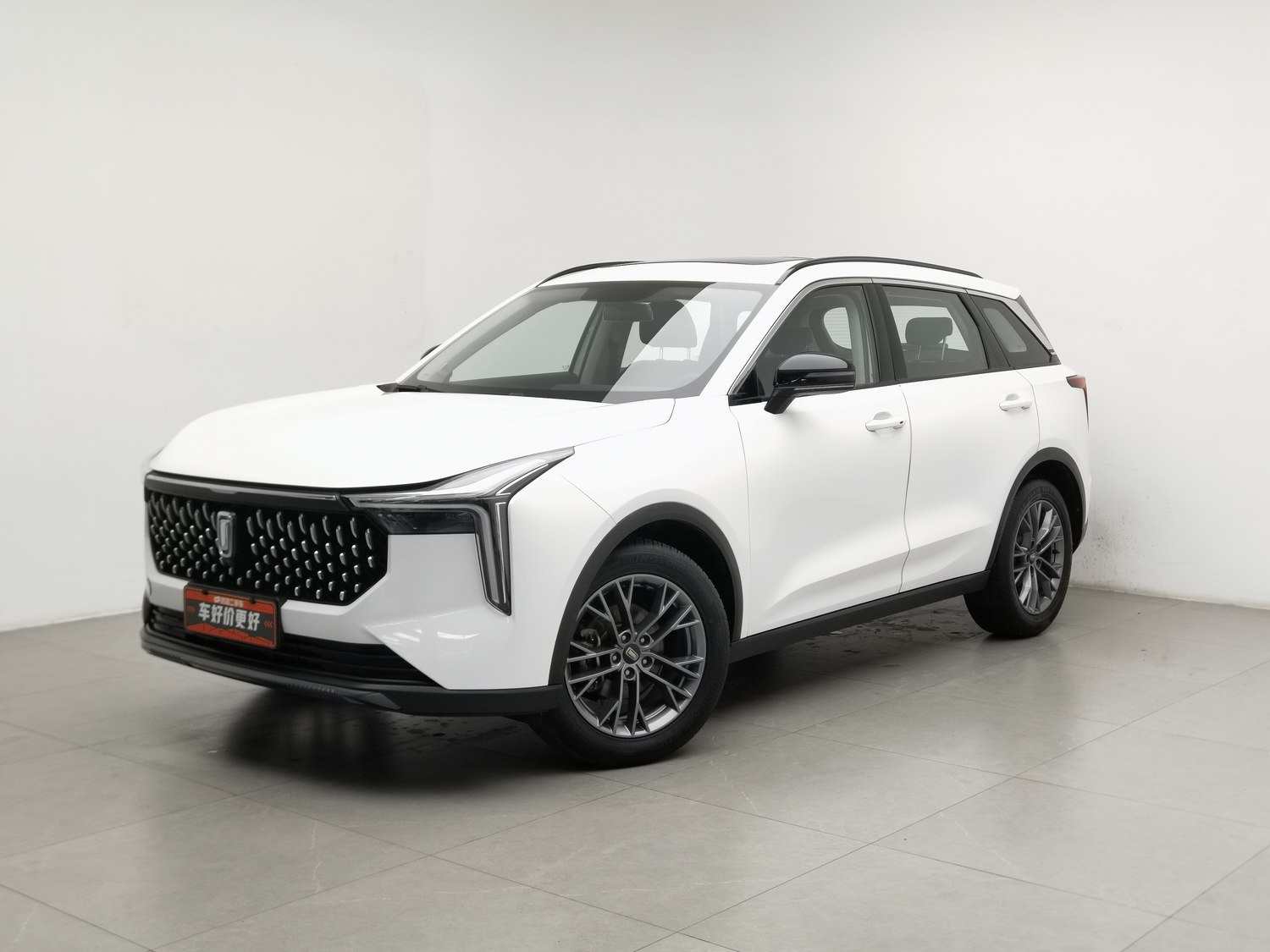
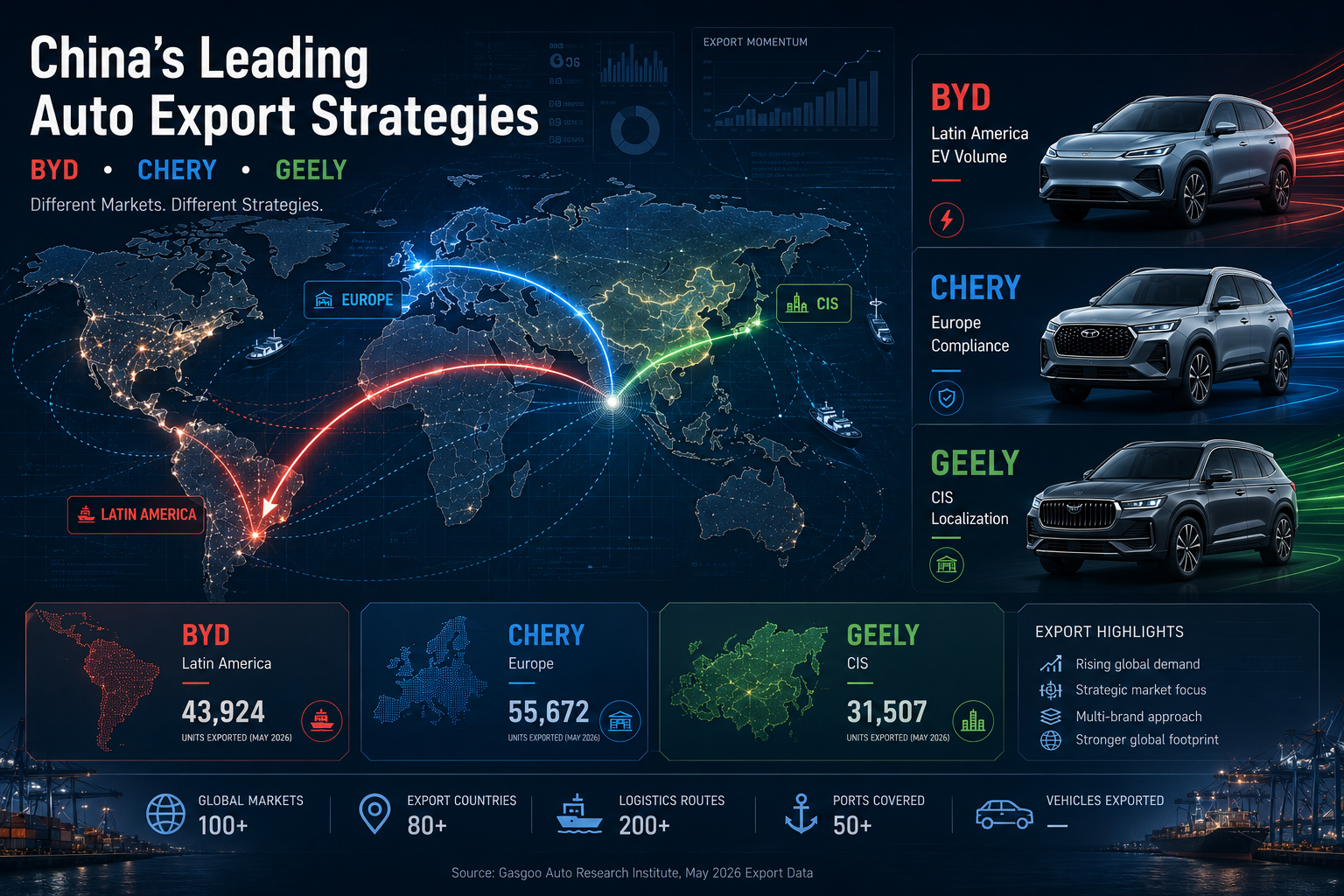
Three Chinese automakers, three divergent export paths. BYD floods Latin America with EVs. Chery cuts through Europe's toughest regulations. Geely builds its CIS fortress. Each offers different margins, risks, and partnership models for overseas dealers. This article breaks down the data and what it means in practice.
The question is no longer whether Chinese automakers will dominate global exports — it's which one a distributor should bet on. Three divergent strategies have emerged among China's top three exporters. BYD floods Latin America with EVs. Chery cuts through Europe's toughest regulatory environment. Geely builds its fortress in the CIS. Each path carries different risks, different margin structures, and different implications for overseas dealers choosing a partner. Here's what the data shows and what it means in practice.
Three Routes, One Market
By May 2026, three distinct export playbooks had crystallized among China's top auto exporters. A dealer in Lagos deciding between brands, a fleet buyer in São Paulo evaluating OEMs, a distributor in Almaty looking for the right partner — each faces a fundamentally different value proposition depending on which Chinese OEM they choose.
The differences are not accidental. They reflect years of deliberate, capital-intensive strategic bets.
BYD: Volume Game in Latin America
BYD shipped 43,924 vehicles to Central and South America in May 2026 — more than its next three regions combined. The spike was driven by Brazil's July tariff increase on imported EVs. BYD pre-shipped aggressively to beat the deadline, cementing its position as the dominant china auto exporter in the region.
A distributor we spoke to in São Paulo described the reality behind the numbers: "BYD arrived with containers, not marketing decks. The vehicles sold themselves on price." That's the BYD playbook — let the cost advantage do the talking.
The question is whether those volumes hold after the tariff-driven pull-forward normalizes. BYD's secondary markets provide some buffer: Southeast Asia at 21,341 units, Europe at 18,366, Oceania at 16,544. But its core thesis remains unchanged — price-competitive EVs for markets that want battery-electric vehicles today.
The distributor reality: BYD's scale gives it procurement advantages no other Chinese OEM can match. In 2025, BYD sold 4.6 million vehicles globally with per-unit profit of 7,087 RMB. Its bargaining power across steel, wiring, glass, and batteries is unmatched. For a wholesale auto dealer evaluating BYD, the key question is not whether BYD can supply volume — it's whether the margin structure in your specific market works at BYD's pricing tier.
Chery: Europe's Surprise Leader
Chery's 55,672 units to the EU, UK, and EFTA in May 2026 is the most strategically significant number in this dataset. It proves a Chinese brand can achieve meaningful volume in the world's most demanding automotive market.
This is not a tariff-avoidance story. Chery faces the same EU duties as every other Chinese exporter. Its success suggests genuine product-market fit, effective homologation strategy, and a distribution network that scales.
One European importer we work with put it bluntly: "Chery showed up with the paperwork done. That's rare for a Chinese brand entering Europe." The homologation investment required to sell at scale in the EU is substantial — Chery has made that bet, and it's paying off.
For wholesale auto dealers in Europe, Chery represents the closest thing to a proven Chinese mass-market play. For distributors outside Europe, the Chery story validates the brand's engineering and compliance capability — useful context when evaluating the brand for regulated markets like Australia or the Gulf states.
Geely: The CIS Fortress
Geely's export profile is the most balanced of the three, with a clear anchor in CIS countries at 31,507 units. Years of localized manufacturing, vehicle customization, and dealer network development have created entry barriers competitors cannot easily replicate.
Geely's secondary markets tell the story of genuine diversification. Southeast Asia at 21,054 units. Europe at 16,137. Latin America at 14,726. Africa at 13,231. No single non-CIS market absorbs more than 21% of Geely's non-CIS exports.
This balance makes Geely a lower-risk partner for distributors in markets where BYD's EV-only focus or Chery's volume requirements may not fit. Geely also reported the strongest profit momentum among the three: Q1 2026 net profit of 4.56 billion RMB, up 31% year-on-year, with per-vehicle profit exceeding 6,400 RMB.
The reality for vehicles exporter organizations evaluating Geely: its multi-brand structure (Geely, Lynk & Co, Zeekr) allows more flexible MOQ arrangements per brand. Dealers can start with one brand and expand as the market develops. Geely's established parts and service infrastructure in CIS also means shorter lead times and better parts availability in that region.
What the Numbers Reveal
| Market | BYD | Geely | Chery |
|---|
| Latin America | 43,924 | 14,726 | — |
| SE Asia | 21,341 | 21,054 | — |
| EU+UK+EFTA | 18,366 | 16,137 | 55,672 |
| CIS | 8,628 | 31,507 | — |
Source: Gasgoo Auto Research Institute, May 2026 export data
BYD plays the volume game. Flood emerging markets with cost-competitive EVs. Accept lower per-unit margin (5,800 RMB per vehicle in Q1 2026). Rely on vertical integration to undercut everyone.
Chery plays the access game. Invest heavily in homologation and distribution infrastructure required to sell at scale in the highest-value export target.
Geely plays the localization game. Build deep roots through local manufacturing and customization. Extend outward with multi-brand flexibility.
The Profit Squeeze Driving Export Urgency
Export expansion is not optional for Chinese automakers — it's survival.
China's automotive industry profit rate fell from 6.1% to 3.2% in Q1 2026, according to the China Passenger Car Association. Per-vehicle gross profit dropped from 23,000 RMB to 14,000 RMB. Storage chip prices surged from 20 to 100 RMB. Lithium carbonate rebounded from 80,000 to 180,000 per ton.
Of 11 listed Chinese automakers, only five posted a profit in Q1 2026. Their combined net profit of 16.595 billion RMB was dwarfed by CATL's 20.738 billion — a single battery supplier earning more than the entire passenger car industry combined.
This margin compression forces every Chinese OEM to seek higher-margin export markets. The question is which route they take — and what that means for the cars suppliers who partner with them.
Procurement Considerations by OEM
Lead times. BYD's vertically integrated supply chain typically allows faster fulfillment. Geely's localized CIS production reduces lead times there but may extend them elsewhere. Chery's homologation pipeline requires longer upfront planning but delivers predictable schedules once certified. For wholesale auto dealers, these differences directly impact inventory planning.
Minimum order quantities. BYD's volume model typically demands larger commitments. Geely's multi-brand structure allows more flexible MOQ arrangements. Chery's European focus requires volume commitments to justify homologation investment.
Compliance and certification. This is the single most important differentiator. BYD prioritizes speed-to-market in EV-friendly regulatory environments. Geely has deep certification experience across CIS, EU, and ASEAN frameworks. Chery invested most heavily in European full-vehicle homologation.
Payment terms. Geely's established export infrastructure in CIS enables more flexible dealer financing. BYD's scale commands stronger bargaining positions. Chery's European push may require distributor investment in service and charging infrastructure.
Distributors evaluating china auto suppliers should verify warranty processing, parts availability timelines, and regional service network requirements. Also verify whether the OEM supports volume rebates, marketing co-op funds, and regional inventory pooling — these operational factors often matter more than vehicle specification.
Frequently Asked Questions
1. Which Chinese OEM offers the best margins for overseas distributors?
Geely reported the strongest profit momentum among the three — Q1 2026 net profit up 31% year-on-year, per-vehicle profit exceeding 6,400 RMB. That said, distributor margins depend on local pricing power, volume commitments, and service revenue. No single OEM universally offers better margins. Evaluate on a per-market, per-model basis. A used car wholesaler may find different margin structures than a new-vehicle franchisee.
2. Can wholesale auto dealers in emerging markets work with more than one Chinese OEM?
Yes. Multi-brand distribution is common in ASEAN, Africa, and Latin America. However, each OEM has different requirements for showroom standards, service equipment, parts inventory, and sales targets. Assess whether your organization has the bandwidth to meet multiple standards before signing exclusive agreements.
3. What's the minimum market size needed to justify a Chinese OEM distributor partnership?
For a full-brand distributor agreement with homologation support and parts warehousing, expect 500–1,000 annual units in an emerging market or 200–500 in a mature market. Below these volumes, a sub-distributor or importer model is more practical. MOQ requirements have been flexible in 2025–2026 as OEMs compete for export channel growth. Request current minimums directly from each OEM's export division.
4. Should a dealer consider used car programs alongside new vehicle distribution?
For distributors in Africa, CIS, and parts of Latin America, a complementary used car program — including bulk used cars from Chinese fleet operators — can capture price-sensitive segments below new-vehicle pricing tiers. Geely's established CIS presence supports a dual new-and-used model well. BYD's rapid model refresh cycle in China also generates late-model inventory suitable for select export markets.
5. How do BYD, Geely, and Chery compare on wholesale car prices?
BYD's vertical integration and 4.6-million-unit scale give it a structural cost advantage. Its wholesale pricing on EVs is typically the most aggressive. Geely's multi-brand structure allows more pricing flexibility per brand tier. Chery's European certification costs are embedded in its pricing. The real comparison should be on total landed cost, not FOB price. Request market-specific wholesale pricing from each OEM.
6. Do Chinese OEMs support trial orders for new distributor partnerships?
Larger OEMs like BYD and Geely typically require initial volume commitments for direct distributor agreements. For smaller-scale entry, working through an experienced china auto exporter who can consolidate multi-brand orders and provide trial shipments — MOQ as low as 1 unit — is a practical path. This approach lets dealers test market response before committing to an exclusive OEM relationship.
About the Author / Sourcing Partner
This analysis was prepared by the supply chain intelligence team at Zacarmate (Zhongan TikTech (Anhui) Co., Ltd.), the state-owned auto export arm of Conch Group (Fortune Global 500). We help international dealers and fleet buyers source vehicles from China across all major OEMs — new and used, single unit or container loads.
How we support global distributors:
Multi-brand sourcing: Access to BYD, Geely, Chery, and all major Chinese OEMs — one point of contact
Flexible volumes: MOQ from 1 unit for market testing; multi-brand consolidation in one container
Quality assurance: Multi-point inspection, verified mileage, zero accident/flood/fire vehicles
Full logistics: Domestic transport, warehousing, Ro-Ro/container/rail shipping, complete export documentation
Global reach: Delivering to the Middle East, Africa, CIS, Latin America, and Southeast Asia
→ Contact our export desk for OEM-specific wholesale pricing and a tailored sourcing plan.

Gasgoo Auto Research Institute, China OEM Export Data (May 2026). Covers BYD, Geely Holding, and Chery Holding wholesale export figures by destination region.
Chinese automaker quarterly financial reports, Q1 2026. Per-vehicle profit calculated as net profit attributable to shareholders divided by total vehicle sales.
China Passenger Car Association (CPCA), "Automotive Industry Profit Analysis," Q1 2026.
Shanghai Metals Market (SMM), lithium carbonate and storage chip pricing data, Q1 2026.
Zhongan TikTech (Anhui) Co., Ltd.
Zhongan TikTech (Anhui) Co., Ltd., a Conch Group SOE, exports quality new & used vehicles globally with 40+ years' foreign trade expertise.
 EN
EN
 fr
fr  es
es  ru
ru  pt
pt