Banner: Looking for a reliable China auto exporter? This guide explains how the margin squeeze is reshaping export pricing and supplier risk. When you're ready to compare wholesale quotes, our team can help you shortlist the survivors. [Get Export Support]
Summary
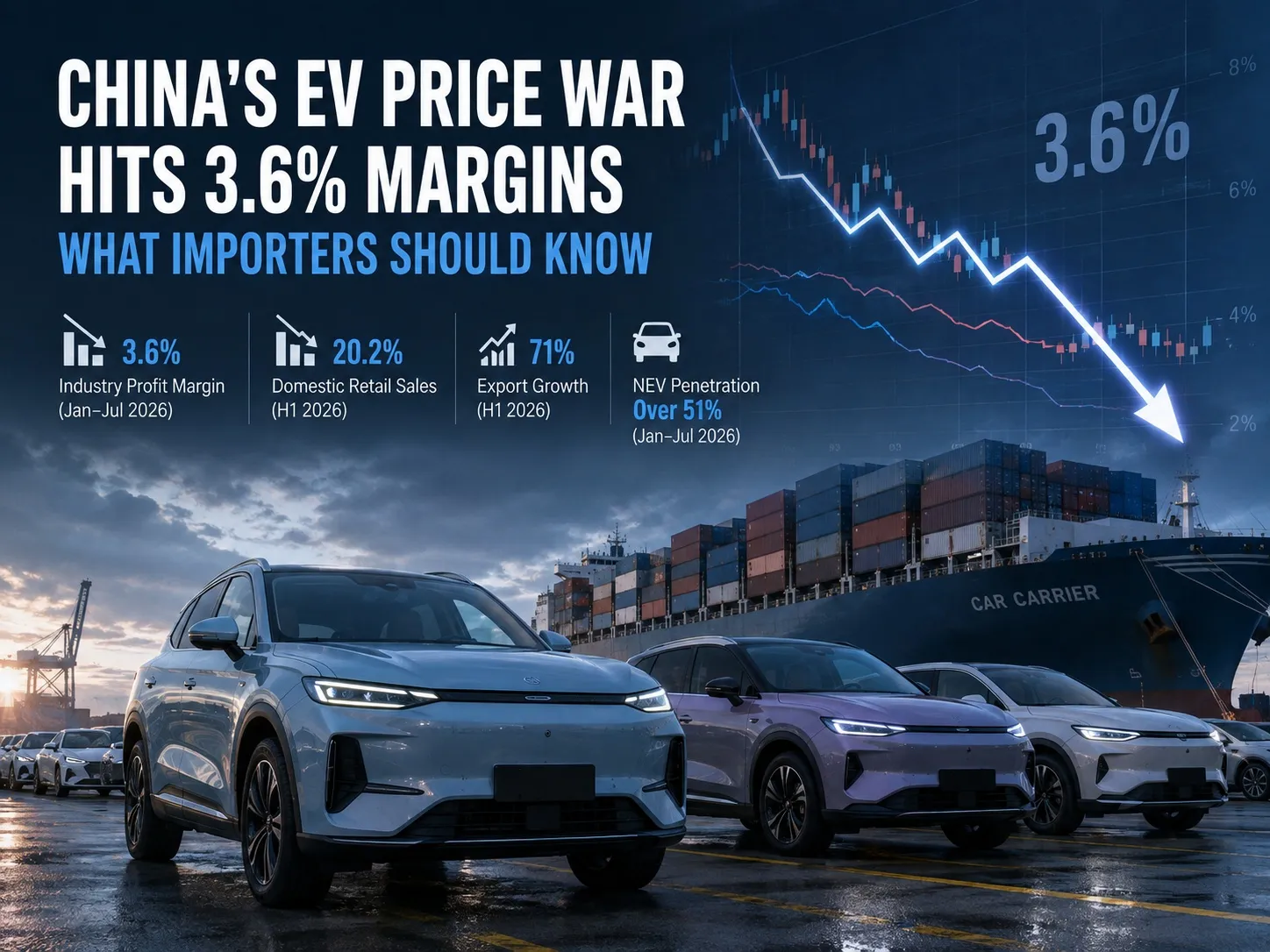
China's auto industry profit margin fell to 3.6% in the first seven months of 2026 — July alone hit just 2.4% — as the domestic market entered an elimination round. Retail dropped 20.2% while exports surged 71%. For importers, that means wholesale car prices at generational lows — and rising supplier risk. Here's how to time your purchase.
The Numbers Behind the 3.6% Margin
Start with what actually happened. Between January and July 2026, China's auto industry generated 6.078 trillion yuan in revenue, up 2.7% year on year. Costs climbed faster — 3.8%, to 5.406 trillion. That gap is the whole story in one line: revenue is growing, and profit is being squeezed out of it. Net profit fell 20% to 216.2 billion yuan, pushing the industry's sales margin to 3.6%. The average for downstream industrial enterprises is 6.5%. Chinese carmakers are now earning roughly half the margin of the broader manufacturing base.
July was worse. Revenue rose 8.3% but costs jumped 10%, and the monthly margin collapsed to 2.4%. Only December 2025's 1.8% was weaker in recent memory. The trend line is unmistakable: 4.3% in 2024, 4.1% in 2025, 3.6% in the first seven months of 2026.
Per-vehicle economics tell the same story from inside the factory. Average revenue per vehicle rose 5.3% to 345,000 yuan. Cost per vehicle rose faster, to 307,000 yuan. Taxes and fees added another 26,000. That leaves a gross profit of roughly 12,000 yuan per vehicle — down 19% in a single year. For context, a mid-size family SUV sells for ten times that amount on the retail lot. The margin isn't thin. It's nearly gone.
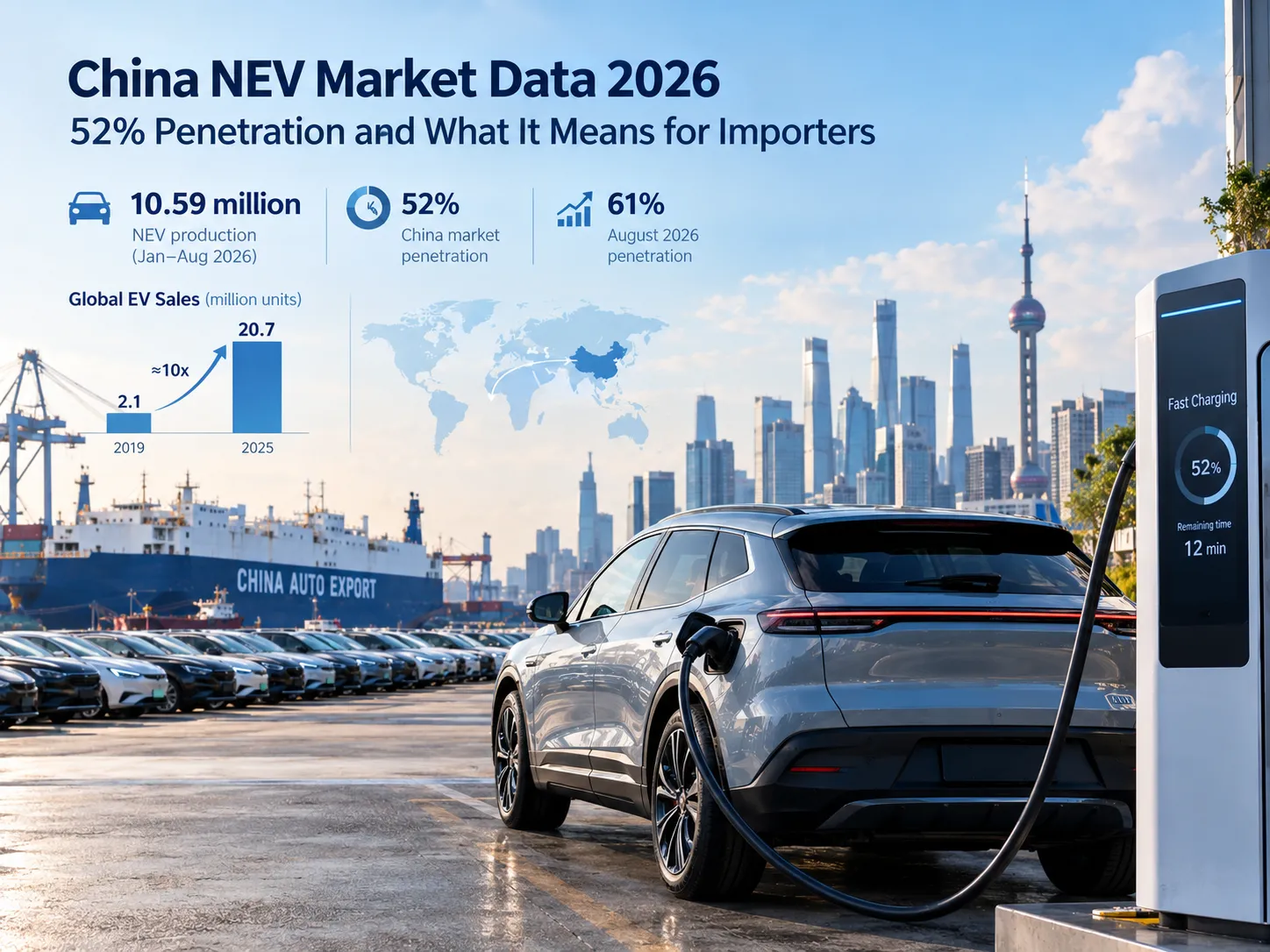
Production volume shows where the market is headed. Total output fell 3% to 17.61 million units, yet new-energy vehicles grew 10% to 8.95 million units and passed 51% penetration. Combustion-engine output dropped 14%. In July alone, NEVs reached 61% of production. The legacy business isn't shrinking slowly; it's being retired.
From Growth Race to Survival Race
China's domestic market contracted hard in the first half of 2026. Retail sales fell 20.2% to 8.701 million units, while wholesale slipped 5.7% to 12.547 million. Exports, by contrast, surged 71% to 4.252 million units. That split is the market's center of gravity shifting — the domestic pie is shrinking, and the industry is looking outward to survive.
NIO founder William Li put a number on it. At a forum in Shanghai this August, he predicted the industry's "final and most brutal stage," saying the last meaningful players will be settled within three to five years. Whether the timeline holds, the mechanism is already visible: Chinese automakers have moved from competing for growth to competing for survival. Analysts describe it as a shift from incremental competition to elimination competition.
What does that look like in practice? We're watching brands cut prices, freeze development programs, consolidate dealer networks, and redirect inventory toward export channels. For overseas buyers, this is the moment the domestic war becomes your pricing opportunity — and your counterparty risk.
Where the Real Fight Is: The 150K-Yuan SUV Market
The sharpest fighting is in the segment that matters most to volume buyers: the 150,000-yuan (roughly $21,000) compact SUV market. In July, retail SUVs at or below this price accounted for about 500,000 of the roughly 800,000 SUVs sold — over 60% of the category. This is where Chinese families buy their first car, and where factories fight for share. For overseas dealers buying wholesale SUVs, this price band is also where the deepest discounts tend to surface.
The sub-segment that's exploding is 150,000–180,000-yuan NEV SUVs. Sales grew 78.3% year on year in the first half of 2026 and now represent 42.1% of the NEV SUV market. Nearly 70% of those buyers are households. Plug-in hybrids dominate the price band, and domestic brands lead — BYD's Sealion 06 passed 86,500 units in the first half, with the Song PLUS DM-i as the family benchmark. Leapmotor's C10 and Deepal's S05 are the dark horses, using aggressive equipment lists to pull buyers away from the joint ventures.
The joint-venture story matters for exporters too. Toyota's Frontlander still sells about 9,600 units a month on brand trust and resale value. But its tech, interior, and chassis specs trail the Chinese competition at the same price. That gap is why we see overseas dealers increasingly spec'ing Chinese PHEVs over comparable JV models — the wholesale price is lower and the equipment list is better.
What the Squeeze Means for Export Pricing
Here's the part importers actually care about. When a factory's gross profit is 12,000 yuan per vehicle and falling, it has two options: hold price and lose share, or cut price and chase volume. Most choose the latter. The result is that FOB prices for Chinese vehicles are at generational lows — and the discounts are being pushed through export channels because domestic demand can't absorb the volume.
That's why exports grew 71% while the home market shrank. Factories need to clear inventory and preserve utilization. Export orders, especially bulk purchases and wholesale allocations, are the release valve.
But cheap is not the same as safe. A price war that has run for two years doesn't stop because margins hit 3.6% — it stops when someone exits. When a brand exits, its vehicles don't disappear from your yard. The parts pipeline does.
One importer we work with in the Gulf told us he can now spec a fully loaded Chinese PHEV SUV at a delivered cost that undercuts a comparable Japanese hybrid by nearly a quarter. His problem is no longer price. It's choosing which brands will still be standing in three years.
When to Buy: Reading the Market Cycle
If you're waiting for a single "bottom," stop. Nobody rings a bell. Instead, read the cycle through signals you can actually track:
Quarter-end and year-end inventory pushes. Factories and dealers need to hit volume targets; FOB terms and volume discounts get noticeably better in the last month of each quarter.
Model-year changeovers. When a model is refreshed, outgoing stock is priced to move. This is when discontinued-trim wholesale deals appear.
Production-cut announcements. When a factory cuts output, current inventory becomes more negotiable — but future supply becomes less certain.
Export policy and certification shifts. Subsidy phase-outs and homologation-rule changes can compress or widen your buying window.
In our experience, the importers who got the best 2025 deals were the ones who committed at quarter-end, took agreed allocation, and secured parts and warranty terms in writing before the factory's next price move. The ones who waited for a lower number often chased a moving target.
That said, timing is only half the equation. The other half is counterparty selection.
Risks Importers Can't Ignore
The price war changes the risk profile of every transaction. Four risks matter more now than they did three years ago:
Brand-exit risk. If a manufacturer loses the survival race, after-sales, parts, and warranty commitments vanish with it. A dealer in Eastern Europe bought 200 units from a mid-tier brand that later froze its export program. The cars were fine. Getting parts was not.
Distressed-seller risk. Factories under margin pressure sometimes accept orders they can't fulfill on schedule. In a falling-price market, late delivery means your margin gets arbitraged away before the ship arrives.
Deposit risk. The more desperate the seller, the more they ask for upfront payment. Escrow and documentary credits are non-negotiable in this environment.
Resale-value risk. If the price war continues, the vehicle you import today may be cheaper at the factory in six months — which compresses your buyers' resale economics.
The reality is that a shakeout rewards selective buyers. Diversification matters: don't put your whole allocation with a single, thinly capitalized brand.
How to Source Smartly in a Shakeout
Sourcing in a shakeout isn't about finding the lowest number. It's about finding the supplier most likely to deliver — on time, with parts support, and without disappearing. A practical checklist:
Check the factory's financial trajectory, not just the sticker price. Margin trends, export volumes, and production-cut news are public and telling.
Prefer China auto suppliers with established export infrastructure — dedicated export models, overseas parts warehouses, and local service networks.
Get warranty and parts commitments in writing before you commit to volume.
Use payment structures that protect you — escrow, L/C, or inspection-based release.
Diversify allocation across two or three healthy brands rather than concentrating on one.
Work with an exporter who knows which factories are bluffing. A good export partner does the financial screening so you don't have to.
That last point is what we do at Zacarmate. We shortlist manufacturers on financial health and export capability, not just on price. Then we negotiate terms that hold up even if the market keeps falling.
FAQ
Is now a good time to import Chinese EVs?
For buyers who can select healthy suppliers and secure terms in writing, yes. FOB and wholesale car prices are at generational lows while margins are being squeezed. The window is real — but it favors disciplined buyers over impulsive ones.
How much have Chinese EV wholesale prices dropped?
The industry-wide gross profit per vehicle fell 19% year on year to about 12,000 yuan, which translates into aggressive factory discounts and export pricing. Specific drops vary by brand and model; volume buyers typically get the deepest concessions at quarter-end.
Which Chinese EV brands are safe to import during the price war?
The safest bets are brands with positive cash flow, growing export volumes, and established overseas parts networks — the top plug-in hybrid players are currently the most resilient. Brands dependent on a single shrinking market are the riskiest.
How long does it take to export a car from China?
Realistic lead times run 4–8 weeks from order to vessel, depending on model, allocation, and port. Add customs, inspection, and shipping, and most importers plan on 6–10 weeks door to door. Distressed factories can slip these windows.
What are the biggest risks of buying Chinese cars while prices are falling?
The main risks are brand exit (parts and warranty disappear), delayed delivery as factories scramble, and deposit exposure with distressed sellers. All are manageable with the right counterparty selection and payment terms.
How can I protect my deposit when buying from Chinese suppliers?
Use escrow or letter-of-credit structures, link payments to inspection milestones, and verify the exporter's track record before transferring funds. A reputable China auto exporter will offer these terms without hesitation — and we do.
Sources
Gasgoo (盖世汽车) via D1EV — "2026年1-7月汽车行业利润率降至3.6% 利润同比下降20%" — d1ev.com/news/shichang/311597
汽车公社 via D1EV — "造车新势力终局已定:只剩3年窗口期" — William Li on the 3–5 year shakeout timeline
汽车公社 via D1EV — "15万级SUV市场的蛋糕,看到容易吃到难" — 150K-yuan SUV market data
National Bureau of Statistics of China — industrial enterprise profits — stats.gov.cn
China Passenger Car Association (乘联会) — retail, wholesale, and export data — cpcaauto.com
About Zacarmate
Zacarmate is a China-based auto exporter serving overseas fleet buyers, wholesalers, dealers, and channel agents. We source new and near-new vehicles directly from financially healthy manufacturers, handle export documentation and logistics, and back every order with transparent pricing and committed parts support.
Quality commitment: vehicles are inspected and title-checked before shipment; export-spec units selected for overseas compliance.
MOQ: flexible — from single units for evaluation to full-container and bulk allocations for wholesalers and dealerships.
Logistics coverage: we arrange shipping from major Chinese ports (Shanghai, Tianjin, Guangzhou) to the Middle East, Africa, Latin America, Central Asia, and Southeast Asia.
Contact: sales@zacarmate.com — tell us your target market and volume, and we'll shortlist the suppliers most likely to survive the shakeout.
Zhongan TikTech (Anhui) Co., Ltd.
Zhongan TikTech (Anhui) Co., Ltd., a Conch Group SOE, exports quality new & used vehicles globally with 40+ years' foreign trade expertise.
 EN
EN
 fr
fr  es
es  ru
ru  pt
pt