Looking to add autonomous vehicles to your fleet? Chinese L4 technology is already moving freight at overseas airports, ports and mines. Read the guide below, then talk to our export team about a tailored procurement plan. [Get Export Support]
Summary
Chinese L4 operators now move real freight at Singapore's Changi Airport, Hong Kong International, the UK's Port of Felixstowe and a Western Australian gold mine. Deployment time for a new airport has fallen from three years to under one. This guide explains what's proven, what's still adapting, and how to structure a fleet-scale purchase.
The Pattern: Chinese L4 Is Entering Real Production Systems
At Singapore's Changi Airport, a Chinese-built driverless fleet has moved into airside operations. On the other side of the world, the UK's Port of Felixstowe is about to run 100 autonomous container trucks — its third order went to Westwell's Q-Truck. And at the Kalgoorlie goldfields in Western Australia, six Komatsu HD1500 haulers now steer themselves using a Chinese autonomy stack fitted onto Japanese iron.
Airport, port, mine. Three very different production floors, one shared shift: Chinese L4 technology is crossing from demonstration projects into live overseas operations.
Yet "going out" and "replicating" are not the same thing. These three cases sit at different levels of maturity, and none of them proves the entire Chinese L4 industry is ready to export. What they do is hand buyers three windows into one practical question — how much of the capability built inside China's complex industrial sites survives contact with a different regulatory system, different equipment and a different operating culture.
That question, not the marketing, is what should drive a procurement decision.
Airports: The Hardest Part Isn't the Algorithm
Airports look easy. Closed perimeter, low speeds, fixed routes, no crowded public roads, no unpredictable pedestrians. It feels simpler than robotaxis by construction.
Look closer and the picture inverts. On a visit to Urumqi Tianshan International Airport in mid-August, UISEE co-founder, chairman and CEO Wu Gansha pointed out the gap: airport aprons have no traffic lights. Aircraft ground movements are still directed by ground staff with flags and hand signals, and vehicles must read the aircraft's own state — wing position, tail lighting, whether it is about to push back.
A human driver absorbs that language in weeks. A machine has to be taught it: when an aircraft may move, what the lights mean, when to hold position and yield. Add snowstorms, ice, fog or desert dust and the perception problem compounds.
So every airport is a different exam. Urumqi, Lhasa, Hong Kong and Singapore do not present the same problem, and going overseas layers regulation, data rules and operating procedures on top of climate and layout.
The deployment data tells the story of accumulated experience. UISEE's prospectus shows a major international airport in northwest China took roughly three years to stand up. Singapore Changi compressed that to about 1.5 years. Hong Kong International went from around two years in 2019, to about one year in 2023, to roughly six months in 2025.
Shrinking timelines mean engineering reuse is real. They do not yet mean the product is standardized.
The scale numbers, published in UISEE's first results since its May Hong Kong listing, are worth a close read: more than 10.2 million kilometers of truly driverless operation; over 1,400 L4 vehicles and retrofit kits deployed across six countries and regions and 249 customers; more than 6 million kilometers at airports alone — 4 million of it at Hong Kong International and 1.6 million at Urumqi. Frost & Sullivan puts UISEE at 90.5 percent of the Greater China airport L4 commercial-vehicle market by 2025 revenue.
Here's the catch for buyers: even at a 90 percent share, penetration sits near one percent. One in every hundred airport ground vehicles is autonomous. The market is not saturated. It has barely started.
There is also a deeper design question any buyer should understand. Most airport rules were written for humans. Instead of forcing the machine to get ever better at reading lights and flags, could the airport simply digitize position, status and right-of-way and push it to the vehicles? Technically plausible. Institutionally brutal — airports, air traffic control, airlines and ground handlers sit inside different authority structures, and cross-department coordination is the real bottleneck.
Until a common machine-readable rulebook exists, every new country and every new airport carries adaptation cost. That is the single most important fact to price into an airport fleet purchase.
Ports: After 100 Trucks, You're Not Just Selling Vehicles
Ports run on a different logic. The container is the most successful standardization project in global logistics. What resists uniformity is the production system wrapped around it.
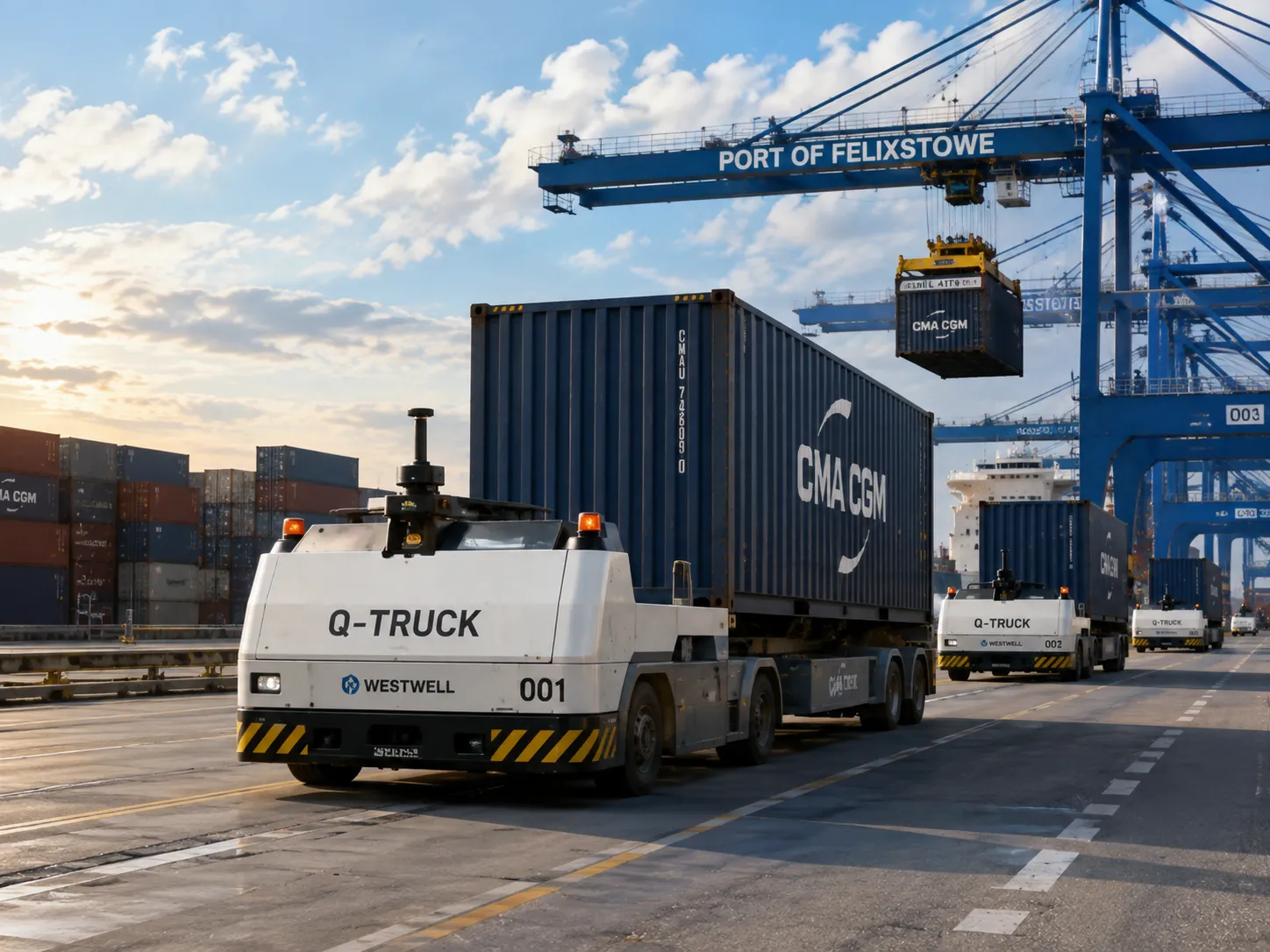
Felixstowe, the UK's busiest container port, confirmed a third order for Westwell's Q-Truck in July. When the current deliveries land, the port's autonomous truck fleet will reach 100 units. Repeat orders — not a pilot, not a showcase — are the evidence that driverless trucks have entered daily terminal production.
But read the deal wrong and you misprice the whole category. A ship berths; quay cranes, container trucks, the yard and yard cranes form one continuous chain. An autonomous truck driving from point A to point B is the simplest step in that chain.
Arrive early and the truck queues. Arrive late and the crane waits. At the yard, if the yard crane is not ready, a new wait forms. When 100 trucks operate together, throughput stops being about how smart any single truck is. It is about who orchestrates the trucks to the terminal's production rhythm.
That is why the more interesting commercial story at ports is the software layer, not the vehicle. A terminal operator we work with put it bluntly: the expensive failure mode is not a truck that drives badly, it is a fleet that arrives at the wrong time. For a fleet buyer the lesson is direct — when a port procures 100 autonomous trucks, it is buying a scheduling and control system that happens to come with vehicles. Negotiate the integration and the uptime guarantee, not just the unit price.
Mines: Chinese Software, Local Hardware
Mining was the quiet proving ground for autonomy before robotaxis existed. What is new is the supplier geography.
At the Kalgoorlie goldfields, six Komatsu HD1500 trucks have been converted with a Chinese autonomous driving system supplied by Yikuang. The company did not ship a batch of Chinese mining trucks to Australia. It shipped software and sensors, and installed its stack into the mine's existing Japanese-built haulers.
Chinese software, local hardware. That is the retrofit model — the same logic behind UISEE's "AI driver" kits — applied to the most demanding vehicle class in the industry, in one of the strictest mining jurisdictions on earth.
Western Australia's Department of Mines requires operators to demonstrate safe integration of autonomous haulage before deployment. That a Chinese retrofit system cleared this process on Komatsu equipment matters. It is evidence that the autonomy layer can be separated from the vehicle platform, which is exactly the flexibility a buyer wants when they are not ready to scrap a working fleet.
Anyone selling mining autonomy should be asked one question: what happens when the OEM updates its machine? Retrofit players live or die on that answer.
What Robotaxis and Battery Swaps Signal to Buyers
Outside the gates, L4 is pushing onto public roads. In late August, XPeng announced its Robotaxi secured Guangzhou's remote-driving test qualification — driverless operation with no safety driver in the main seat, on the city's tier-one, tier-two and tier-three public roads, backed by cloud-based remote monitoring and takeover.
The same week, NIO Energy delivered the first 23 industry-cooperation battery swap stations with Science City (Guangzhou) in Huangpu. On the surface these are separate stories. Together they signal two procurement facts.
One architecture, L2 to L4. The capability chain is consolidating under a single physical-world AI foundation running assisted and autonomous driving. Buyers no longer need to bet on a niche supplier for the L4 step.
Energy is part of the fleet decision. Battery swap, charging networks and depot electrification determine whether an autonomous fleet can actually stay on the road. A fleet is only as autonomous as its energy supply chain.
A Buyer's Checklist Before You Commit
Before signing anything, work through these eight points with the supplier:
Match the reference site. Ask for the deployment that most closely mirrors your operating environment — climate, traffic mix, regulatory regime — not merely the most impressive one.
Verify the certification path. UNECE WP.29 regulations (R155 cybersecurity, R156 software update management) increasingly gate market entry across Europe and aligned markets. Confirm who carries homologation cost and timeline.
Choose retrofit versus new-build deliberately. If you have a healthy existing fleet, retrofit may cut capex sharply. If you need reliability guarantees on greenfield operations, factory-integrated vehicles may serve better.
Ask who holds the operations layer. Vehicle, software and operations can now come from three different companies. A single accountable party reduces finger-pointing when uptime slips.
Structure the commercial model. Subscription and per-kilometer pricing are now common and can move L4 from a capital purchase into an operating expense.
Model full lifecycle cost. Include energy, maintenance, remote supervision and downtime — not just the vehicle price.
Confirm data residency and cybersecurity compliance. Where fleet data is processed, who owns it, and how it is protected is a legal issue in many markets, not a technical footnote.
Demand an uptime SLA and a local service partner. Autonomy that cannot be serviced locally is a liability, however smart the truck.
The Commercial Model: AI Drivers, Subscriptions and TCO
UISEE's first half-year results as a listed company frame the shift. Revenue reached RMB 163 million, up 64.9 percent year on year, with gross margin at 52.9 percent. Vehicle solution revenue rose 29.9 percent; software solutions grew 56.1 percent. The fast-growing line was retrofit kits — RMB 25.1 million, about 15.4 percent of total revenue, with shipments up more than six times year on year.
The kit business is the "AI driver" model in action. Instead of buying a new autonomous vehicle, a customer retrofits an existing one and subscribes to the driving capability, priced by usage or period. Wu Gansha describes the target company as an "AI labor force" provider: vehicles built by OEMs, operations run by local partners, with the autonomy layer supplied in between.
The economics matter to buyers. A subscription turns a large capital outlay into a predictable operating cost, and it aligns the supplier's incentive with uptime rather than unit sales. The catch is lock-in — understand the exit terms, the data portability, and what happens to your retrofitted vehicles if the subscription lapses.
The underlying arithmetic is the same in every scenario. An autonomous vehicle that merely adds cost to a human-driven operation does not win a procurement. It wins only when it replaces driver labor and its full-lifecycle cost falls below the human baseline. For airports, that means replacing ground vehicle operators; for mines, haul-truck drivers; for ports, the same math across hundreds of trucks. Buyers who model it that way — not on hardware price — are the ones getting deals signed.
FAQ
Q1: Are Chinese L4 autonomous vehicles already operating overseas?
Yes. UISEE runs driverless fleets airside at Singapore's Changi Airport and Hong Kong International. Westwell's Q-Truck operates at the UK's Port of Felixstowe, where a third order will bring the autonomous fleet to 100 trucks. Yikuang has retrofitted Komatsu haulers at a Western Australian gold mine. These are production operations, not pilots.
Q2: Which Chinese companies lead L4 deployment at airports, ports and mines?
UISEE leads in airport ground operations, with a 90.5 percent share of the Greater China airport L4 commercial-vehicle market by 2025 revenue. Westwell leads in automated container terminals, and Yikuang is a front-runner in mine haulage. XPeng is pushing L4 onto public roads through remote-tested robotaxis in Guangzhou.
Q3: How long does an L4 airport deployment take?
It has fallen from roughly three years at a major northwest China airport to about 1.5 years at Changi and as little as six months for recent Hong Kong International phases. Expect shorter timelines where the supplier has already adapted to similar climate and operating rules — and budget more where it has not.
Q4: Can existing trucks be retrofitted with autonomous driving systems?
Yes. UISEE sells retrofit kits that convert existing vehicles into "AI drivers," and Yikuang installed its system into Komatsu haulers in Australia rather than shipping new trucks. Retrofit is the fastest path to autonomy for fleets with healthy remaining service life, but confirm OEM support and data access before committing.
Q5: What does an autonomous fleet cost, and is there a subscription option?
Pricing varies by vehicle class and scenario, but subscription and per-use pricing are now standard for the software layer. UISEE's kit business, for example, grew shipments more than six times year on year. Buyers should compare a capital purchase against a subscription by modeling total cost of ownership, including energy, supervision and downtime.
Q6: How do I procure or export Chinese L4 commercial vehicles as a fleet buyer?
Start by selecting an exporter that understands both vehicle sourcing and the autonomy ecosystem — one that can aggregate fleets, handle export documentation, and connect you with OEM or retrofit suppliers. For wholesale vehicle sales and bulk fleet orders, a China-based exporter like Zacarmate can source autonomous-ready commercial vehicles, manage homologation paperwork, and arrange delivery to your port.
Sources
Port of Felixstowe — official announcements on Q-Truck orders — third order of Westwell Q-Truck autonomous trucks, fleet to reach 100 units.
UISEE Technology Co., Ltd. — 2026 Interim Results Announcement, HKEX (01511.HK) — H1 2026 revenue RMB 163M, +64.9%; gross margin 52.9%; deployment and penetration data.
UNECE — World Forum for Harmonization of Vehicle Regulations (WP.29) — R155/R156 framework relevant to autonomous vehicle market entry.
Changi Airport Group — official site — airside operations context for autonomous ground vehicles.
Government of Western Australia — Department of Mines, Industry Regulation and Safety — autonomous haulage integration requirements for mining operations.
About Zacarmate
Zacarmate is a China-based auto exporter serving wholesale buyers, dealerships and fleet operators across Southeast Asia, the Middle East, Africa and Latin America. We source and export passenger cars, SUVs, pickups and commercial vehicles directly from Chinese manufacturers, with pre-shipment inspection, export documentation and freight arranged in-house. We work with single-container loads and aggregate orders for buyers who need mixed fleets, and we can connect you with autonomous-vehicle and retrofit suppliers. Delivery coverage includes Ro-Ro and container sea freight to all major world ports. Contact our export team through the website for a tailored quote on your next fleet order.
Zhongan TikTech (Anhui) Co., Ltd.
Zhongan TikTech (Anhui) Co., Ltd., a Conch Group SOE, exports quality new & used vehicles globally with 40+ years' foreign trade expertise.
 EN
EN
 fr
fr  es
es  ru
ru  pt
pt