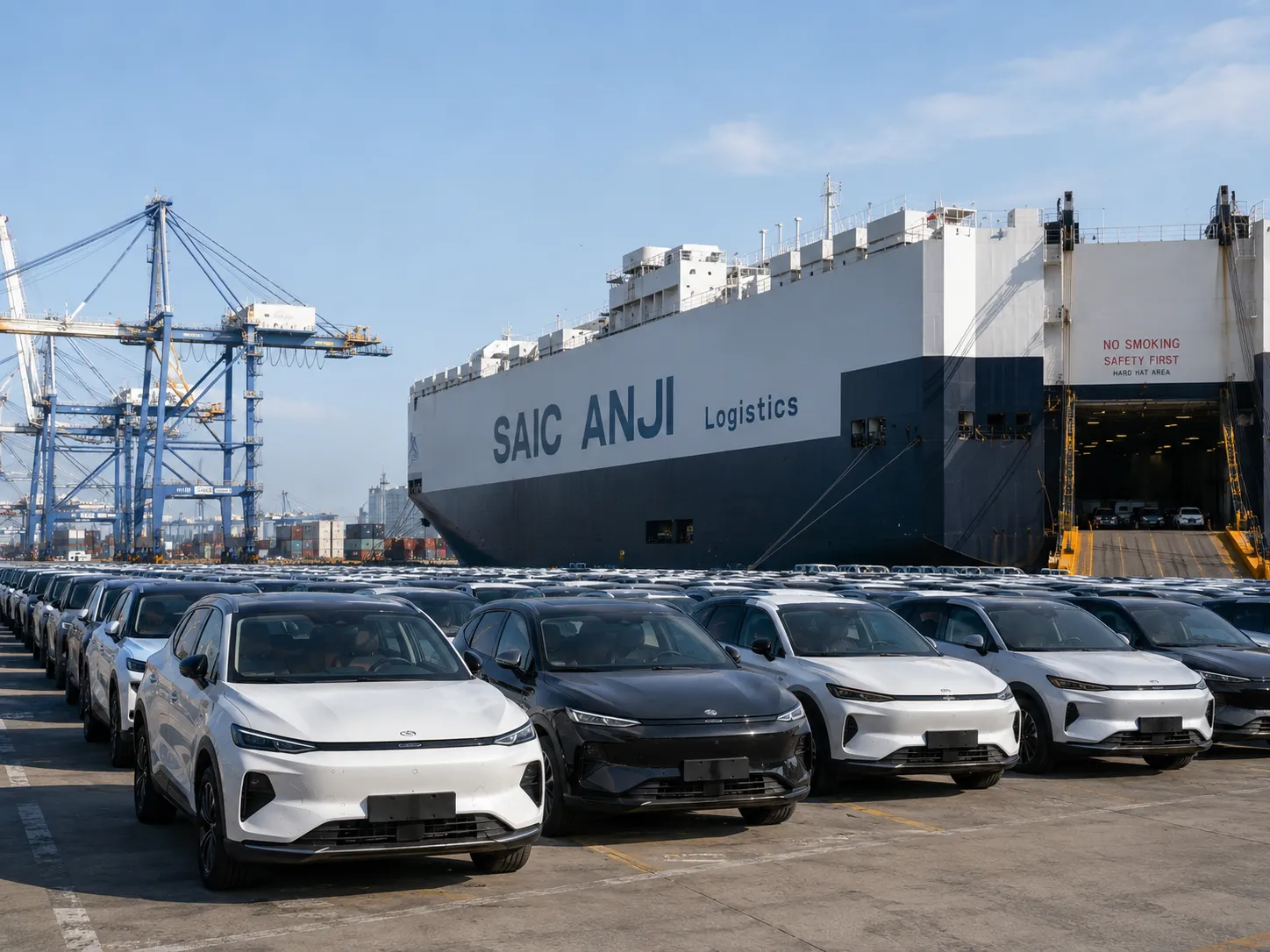
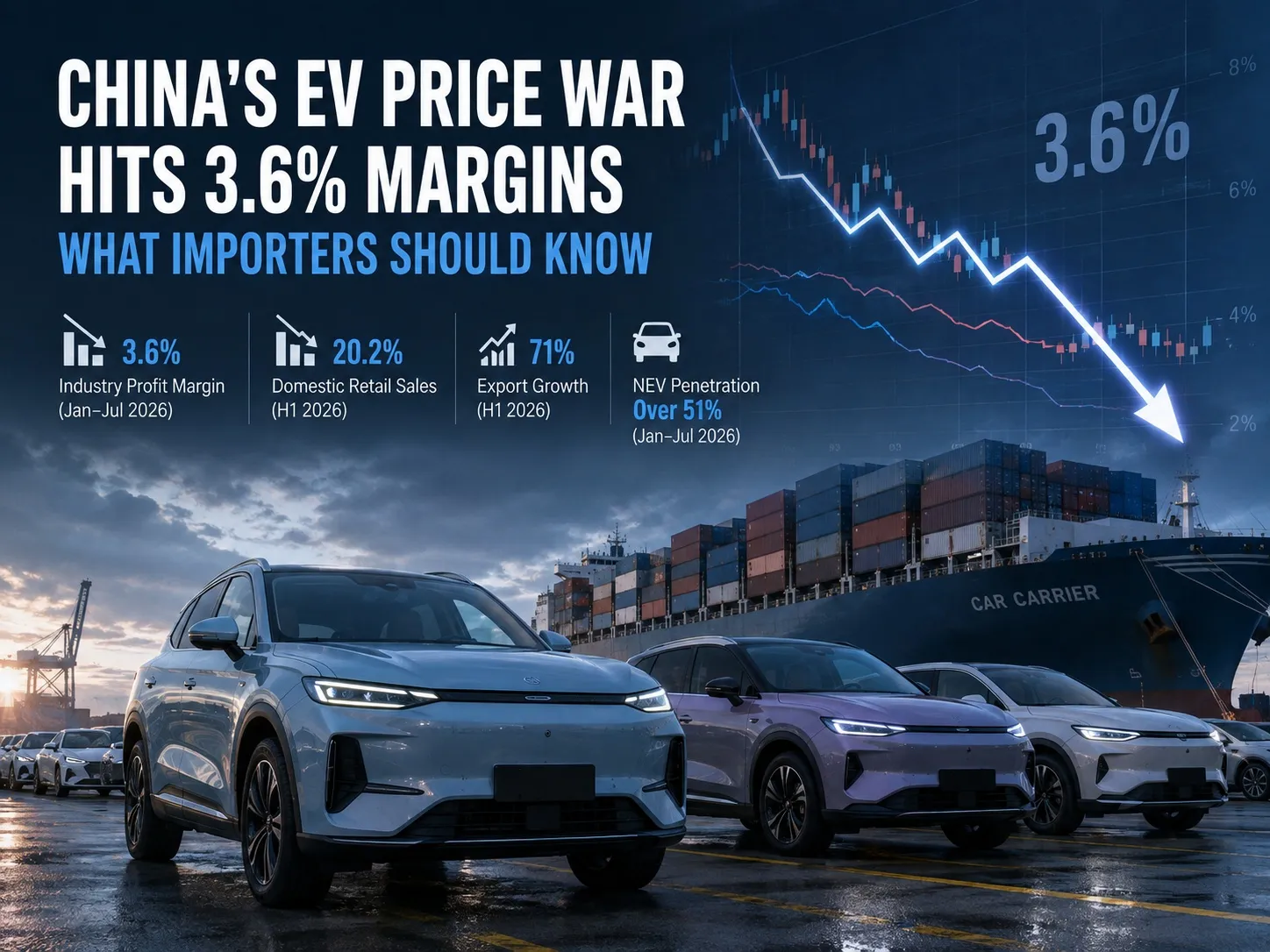
Summary
China's three trade regulators issued a 20-article compliance guideline for auto exporters on September 2, covering overseas pricing, dealer management and data governance. BYD and Chery responded within a day. For overseas buyers, the rule signals more stable pricing and tighter dealer contracts — and some new compliance costs that may find their way into invoices.
What the New Guideline Actually Says
On September 2, China's Ministry of Commerce, Ministry of Industry and Information Technology, and State Administration for Market Regulation jointly issued the Guidelines for Overseas Competition Behavior and Compliance Construction in the Automobile Industry (Shang He Han [2026] No. 451).[1] Twenty articles in total, and not a new license or approval — the regulators are careful to call it a "general guideline."
Four areas matter most for anyone buying from a China auto exporter. First, pricing discipline: exporters are expected to run a scientific pricing system and curb the aggressive undercutting that triggers anti-dumping complaints. Second, dealer management — how distributors are chosen, how terminal retail prices are set, how promotions are run. Third, advertising and data governance: what claims can be made in overseas markets, where customer data sits and how it moves. Fourth, the compliance stack behind all of it — anti-monopoly, intellectual property, labor rights, anti-corruption.
The phrasing is soft. That's the point. A binding rule would invite WTO complaints; a guideline sets a standard the entire industry can be held to later in a review. In practice, the effect was almost immediate — BYD and Chery both published commitments within a day to build a scientific pricing system and standardize terminal pricing and promotional behavior.
Why Overseas Buyers Should Care
It's easy to write this off as Beijing's internal housekeeping. It isn't. It changes what lands on your desk.
The most visible shift is pricing. The old playbook — a China auto supplier winning your order by being 8–12% cheaper than everyone else — is precisely what the guideline targets. When exporters can no longer price purely to take share, the wildest discounts thin out. That's good for market stability, but it means your negotiation has to lean on total cost, freight, warranty and parts availability rather than headline price alone.
There's a second effect on dealer contracts. Chinese OEMs and exporters are already rewriting their distribution agreements to carry compliance clauses — terminal price floors, promotion approval, data-handling obligations. One distributor we work with in Latin America had to re-sign his territory agreement this quarter because his supplier added a pricing-governance annex. If you carry a Chinese brand, expect your next renewal to look different.
Here's the thing: this raises short-term compliance cost. Long term, it de-risks the whole supply chain. An exporter who survives a compliance review is one less supplier likely to disappear mid-order because of a dumping investigation or a frozen customs lane. A dealer in Lagos we know put it plainly — he stopped trusting the cheapest quote after one supplier went quiet on him last year.
The Numbers Behind the Policy
The guideline didn't arrive in a vacuum. It landed in the middle of a record export run.
China exported 5.096 million vehicles in the first half of 2026, up 65.3% year on year — a new half-year record.[2] The growth is broad, but the concentration is telling. Chery exported 943,800 units in H1, up 71.5%. BYD shipped 792,000 units abroad, up 67.8%, with overseas revenue hitting RMB 181.3 billion — 52.6% of its total. Foreign markets are no longer a side business; they're the main event. Geely grew exports 158% to 474,200 units. Great Wall's overseas volume rose 45.5% to 289,000 units, surpassing its domestic sales for the first time.
The momentum extends past the majors. Leapmotor exported 113,863 units in the first seven months, already 75.9% of its full-year target. SAIC moved 410,000 units including overseas-base output through August, up 49%.[5] XPeng's Q2 overseas deliveries topped 20,000, up 81%.
When a sector grows this fast, regulators move. The guideline is the official answer to a simple fact: China's auto globalization has shifted from incremental add-on to strategic core. That shift invites scrutiny — and the guideline is meant to pre-empt it.
What BYD and Chery's Response Signals
In diplomacy, speed is a statement. In compliance, it is too. BYD and Chery responded within a day, before most export managers had finished reading the document.
The two companies are China's most visible exporters, which makes them the most likely targets of any anti-subsidy or anti-dumping review. By volunteering compliance first, they're building a defensible paper trail. For a buyer, that's valuable: a supplier with a documented compliance posture is one less likely to get caught in a tariff review that suddenly rewrites your landed cost.
It also previews where the whole field is heading. Smaller exporters will copy the two leaders' templates within a quarter or two. The contracts you sign in 2026 will carry the same pricing and dealer-governance language whether you buy from a top-five OEM or a mid-tier wholesaler.
The Real Risks: Freight, Currency, Rebates
Compliance is only one pressure on your landed cost. Three others are squeezing margins right now, and they're bigger in dollar terms.
Freight has turned expensive. Daily charter rates for a standard 6,500-CEU pure car and truck carrier have doubled, now running $80,000–90,000 a day against roughly $42,500 at the end of 2025. Slots are booked toward 2028. A fleet buyer we quoted for Q4 delivery watched his freight line item nearly double between two quotes three weeks apart. That single variable can outweigh any rebate on the table.
Currency isn't helping. The yuan's central parity held around 6.78 to the dollar in early September, and the euro reference rate sat near 7.78.[4] A firming yuan quietly erodes export margins on every invoice denominated in dollars or euros.
Then there's the battery rebate. The VAT export rebate on batteries has already been cut from 9% to 6% and is scheduled to be removed entirely in 2027, with a new 2% consumption tax layered on top. That's a slow, structural cost increase flowing into EV pricing over the next two years.
Add the standing question over the EU's anti-subsidy duties — whether they extend from pure BEVs to plug-in hybrids — and you have a genuine set of variables. The reality is, this is where a strong China auto exporter earns its fee: locking freight early, hedging currency, and pricing transparently enough that you can see the whole cost stack.
How to Protect Your Sourcing in 2026
None of this means you should delay a purchase. It means you should qualify your supplier differently.
Ask for the compliance documentation first — pricing policy, dealer agreement templates, data-handling notes. A China auto exporter that can't produce these in 2026 is one you shouldn't send a deposit to. Then lock logistics early: freight is the largest variable in your landed cost this year, and early booking is the only real hedge. Finally, build your model on total cost of ownership — warranty, parts lead time, homologation support — not on the lowest quote.
The exporters who welcome those questions are the ones the guideline was actually designed to favor. That's the trade you want to be on.
FAQ
What is China's auto export compliance guideline?
It's a 20-article document issued on September 2, 2026 by the Ministry of Commerce, MIIT and SAMR, setting expectations for how Chinese auto exporters price vehicles, manage dealers, run advertising, handle data, and uphold IP, labor and anti-corruption standards overseas.
Who issued the guideline?
Three ministries jointly: the Ministry of Commerce, the Ministry of Industry and Information Technology, and the State Administration for Market Regulation. It carries the reference Shang He Han [2026] No. 451.
Will China's new compliance rules raise car prices?
Not directly, and not immediately. It disciplines the most aggressive discounting rather than adding a tax. Some compliance cost gets absorbed by exporters, and any pass-through is small next to this year's real cost drivers — freight and currency.
Which Chinese car companies export the most?
By volume, Chery led H1 2026 with 943,800 units, followed by BYD at 792,000 and Geely at 474,200. Great Wall, SAIC, Leapmotor and XPeng are also growing fast.
Is it safe to buy from a China auto exporter?
It depends entirely on the exporter. The guideline gives you a concrete way to test one: request their pricing policy, dealer agreement and data-handling documentation. A supplier that produces these readily is doing it right.
How do I find a compliant China auto exporter?
Look for an exporter that responded to the guideline, maintains a documented pricing system, and can show you the full cost stack — freight, currency, rebates — before you commit. That's the standard Zacarmate works to on every order.
Sources
Xinhua (English) — China issues guideline on auto industry's overseas competition and compliance — chinaview.cn
China Daily — China's auto exports surge in H1 2026 (BYD, Chery, Geely, Great Wall data) — chinadaily.com.cn
China Association of Automobile Manufacturers (CAAM) via Economic Information Daily — 5.096 million vehicles exported in H1 2026, up 65.3%.
European Central Bank — EUR/CNY reference rate, September 2, 2026.
SAIC Motor — August 2026 export and overseas-base sales release.
About Zacarmate
Zacarmate is a China-based auto exporter supplying fleet buyers, wholesalers and distributors across Latin America, Southeast Asia, the Middle East and Africa. We work to the compliance standards the new guideline describes — documented pricing, transparent dealer terms, and a full cost breakdown on every quote.
What we supply: New and quality pre-owned sedans, SUVs, pickups and EVs from Chery, BYD, Geely, Great Wall and other certified manufacturers.
Quality: Pre-shipment inspection on every unit; VIN-verified documentation and homologation support for your market.
MOQ: Flexible — from single-unit samples to bulk fleet orders and full-container mixed loads.
Logistics: Port-to-port and door-to-door coverage across major Chinese ports, with early freight booking to protect your landed cost.
Contact: Get a tailored quote and a compliance-ready export plan for your market.
[Get Export Support]
Zhongan TikTech (Anhui) Co., Ltd.
Zhongan TikTech (Anhui) Co., Ltd., a Conch Group SOE, exports quality new & used vehicles globally with 40+ years' foreign trade expertise.
 EN
EN
 fr
fr  es
es  ru
ru  pt
pt